
 By Camille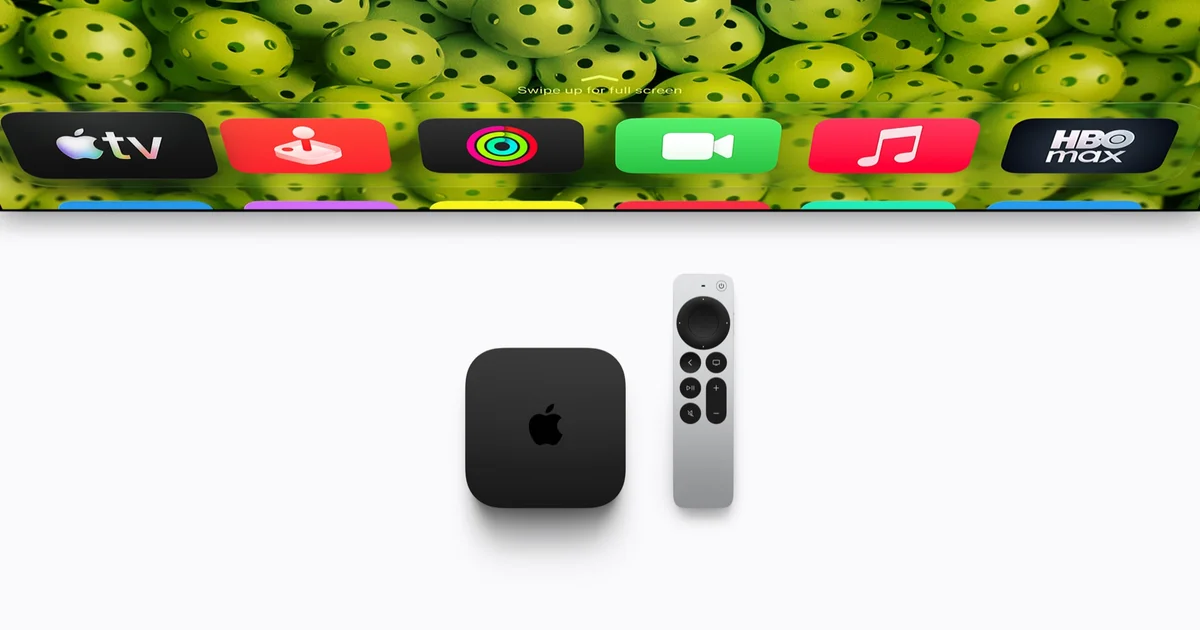
At $299, Apple TV 4K enters a different price category
Apple unveiled its fourth-generation Apple TV 4K at the Welcome Home event on October 13, 2026. Preorders opened in supported markets that day, with retail availability scheduled for November 13.
The American price is $299. In Germany, Apple lists the device at €349 including VAT, placing it well above the budget streaming products available from competing manufacturers.
The increase is significant because the previous Apple TV 4K generation had become more attractive partly through a more accessible price. Apple is now asking customers to spend considerably more for improvements whose practical value will depend on the equipment they already own.
The familiar compact design remains. Most of the important changes are internal or functional, including a new processor, built-in microphones, a more capable remote, expanded audio options and additional software features.
The question is not simply whether the new Apple TV is faster. It is whether those improvements justify the premium when a smart television or an older streaming box already provides access to the most popular services.
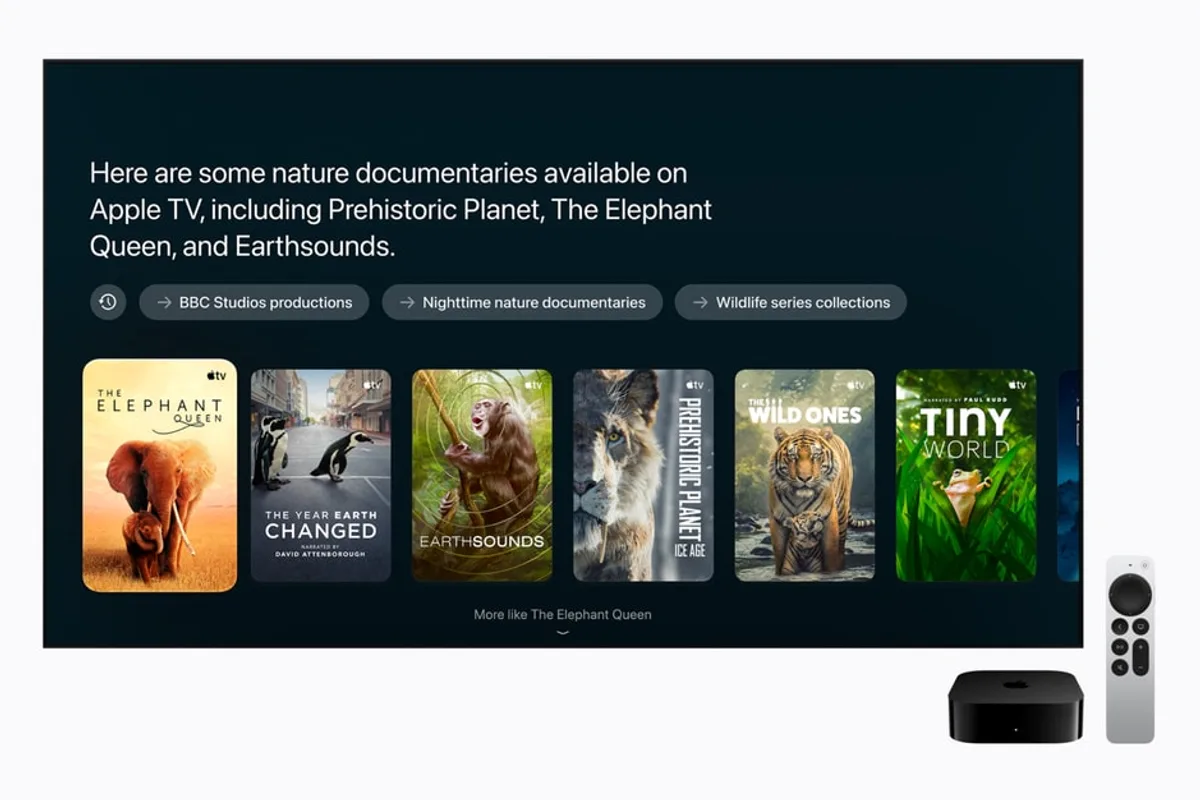
Siri AI turns movie searches into conversations
Apple is making Siri AI the central element of the announcement. Powered by the next generation of Apple Intelligence, the assistant is designed to understand more flexible requests than traditional television voice commands.
Users can ask questions without knowing the exact name of a program. In one official example, Apple demonstrates a request for Apple TV series that won Emmy Awards during the year, followed by additional suggestions involving award-winning comedies.
The assistant can also respond to questions while a program is playing. Apple highlights requests about filming locations or whether a particular show is appropriate for a teenager. Answers are displayed in a smaller overlay intended to avoid unnecessarily interrupting the viewing experience.
The potential benefit is obvious. Streaming services have become crowded with categories, recommendations and extensive catalogs. Finding a half-remembered movie or identifying a show that meets several preferences can require repeated searches.
A genuinely conversational interface could reduce that effort by allowing viewers to describe what they want directly.
Apple also promises access to personal context when the streaming box is connected to a compatible Apple Intelligence-enabled iPhone or iPad. One example involves asking Siri to play a show recommended by someone in a message.
That extends the concept beyond ordinary catalog search. The assistant would need to interpret information associated with another personal device and connect it to an available piece of entertainment.
These are capabilities demonstrated and described by Apple, not independent proof that every request will work reliably. Ambiguous titles, incomplete recommendations and inconsistent catalog availability may all present challenges that need to be tested.
Siri AI is not launching in the European Union
The most consequential limitation for European customers concerns availability. Apple says the Siri AI beta is initially supported in eight English-language markets: the United States, United Kingdom, Canada, Australia, New Zealand, Singapore, South Africa and India.
The European Union is excluded from this initial rollout. It would therefore be inaccurate to suggest that a customer purchasing the new Apple TV 4K in France or Germany will immediately receive the same conversational experience advertised to American buyers.
The distinction becomes even more relevant because Siri AI is not completely exclusive to the new device. Apple confirms that the beta can also run on second-generation Apple TV 4K models and later, provided the relevant hardware, language and software requirements are satisfied.
This creates a separation between the hardware upgrade and the new software experience. The fourth-generation model offers a newer processor and built-in microphones, but not every Siri AI feature requires purchasing it.
The far-field microphones support Siri interaction in several languages, including French and German, under Apple's stated tvOS language requirements.
That compatibility does not mean the full Siri AI experience is available in those languages or regions. Conventional voice control and the newly announced conversational AI features have different availability conditions.
Apple has not confirmed a specific date for bringing Siri AI to the European Union. Any suggestion of an imminent French or German launch would therefore go beyond the official announcement.
Three microphones make voice control fully hands-free
The most visible hardware change supporting voice interaction is the inclusion of three far-field microphones in the streaming box.
Apple TV voice control previously depended heavily on the Siri Remote. With the new model, Apple says users can address the assistant without picking up the remote.
The company also describes an advanced echo-cancellation system designed to isolate speech from background audio, even when television content is playing.
This could meaningfully change the experience. Voice commands that require finding a remote and holding a button often feel like an alternative method of using the interface rather than a genuine shortcut.
Hands-free operation may remove that friction, provided the microphones reliably recognize users from across a room.
Real-world performance remains unverified. Multiple conversations, high playback volume and placement inside furniture could affect recognition. The existence of three microphones is confirmed, but consistent accuracy under difficult conditions will require independent testing.
The A19 chip adds performance and dedicated AV1 decoding
Apple replaces the previous generation's A15 Bionic with an A19 processor. The company claims up to 50 percent faster CPU performance and twice the graphics performance compared with its predecessor.
Those figures are manufacturer claims rather than independent benchmark results. They describe potential improvements under Apple's testing conditions, not guaranteed gains across every application.
For ordinary video streaming, processing requirements are relatively modest once a video stream is decoded efficiently. The additional performance may be more noticeable when navigating the interface, switching applications or playing Apple Arcade games.
A dedicated hardware AV1 decoder is directly relevant to video playback. AV1 can deliver efficient compression, potentially reducing the bandwidth required for high-quality streams.
It does not automatically produce a visibly better image on every service. The benefit depends on the codec used by the platform, the quality of its encoding and the network connection.
For households with limited bandwidth, however, efficient AV1 decoding may become increasingly useful as more services support the format.
The device also includes 128GB of storage, Ethernet, Wi-Fi 7 and Bluetooth 6, according to the specifications reported by The Verge. Support for Thread and Matter remains available for smart-home accessories.
These improvements reinforce Apple's effort to position the device as more than a basic video player. Processing power now supports applications, gaming and a broader connected-home environment.
The new Siri Remote finally becomes easier to find
One of the most practical upgrades is also one of the least glamorous. The new Siri Remote supports Find My with Precision Finding, allowing compatible iPhones to help locate a misplaced remote.
Apple also includes the ability to make the remote produce an audible sound, a useful addition for anyone familiar with searching between sofa cushions.
Compatibility restrictions apply. Precision Finding requires the fourth-generation remote, a supported iPhone and up-to-date iOS software. Apple identifies compatible devices including iPhone Duo, iPhone Air and iPhone 17 or later, excluding iPhone 17e.
The ability to play a sound is exclusive to the latest Siri Remote. Owners should not assume that every older remote will receive identical functionality through a software update.
The improvement may sound minor next to Siri AI, but practical convenience often matters more than a headline feature used only occasionally.
Four HomePods create Apple's new surround-sound system
Apple is also expanding the Apple TV's role in home theater. The fourth-generation model can connect to four compatible HomePod speakers arranged into front and rear pairs.
Supported configurations include four second-generation HomePods, four HomePod mini 2 speakers or matching front and rear pairs using the two types.
Apple says the speakers can identify their relative positioning and automatically adjust timing and audio levels to suit the room.

The appeal is convenience. Traditional surround-sound installations often require an AV receiver, speaker wiring, channel configuration and room calibration.
An Apple-controlled wireless setup could simplify several of those steps. But the price of the streaming box does not include the speakers, and buying four compatible HomePods substantially increases the total cost.
The result will also depend on the room, speaker placement and the expectations of the listener. Apple's claim that this is its most immersive home-theater setup does not replace independent measurements of sound imaging, dynamic range or dialogue clarity.
Four compact speakers are not automatically equivalent to a dedicated home-theater system with specialized speakers and a separate subwoofer. Evaluating those compromises will be important once review units are available.
Apple TV is becoming a broader smart-home hub
The streaming box continues to operate as an Apple Home hub, allowing users to control compatible accessories, manage automations and activate predefined scenes.
Thread and Matter compatibility remain important parts of the device's connected-home role.
Apple is also introducing AI-generated activity descriptions for certain HomeKit Secure Video cameras, along with summarized notifications in the Home app.
These capabilities require compatible equipment and, in some cases, an appropriate iCloud+ subscription. They should not be understood as universally available functions included without conditions for every customer.
The wider strategy is to make the living-room television a control point for more than entertainment.
Apple's simultaneous announcements of HomeView, HomePod mini 2 and additional smart-home accessories reinforce that direction. Apple TV 4K is becoming one component in a larger integrated environment.
Privacy becomes a major question for a more personal Siri
An AI assistant that can refer to personal messages when searching for entertainment naturally raises privacy questions.
Apple says the new device uses protected processing environments called Secure Exclaves to isolate certain microphone-related operations from the rest of the system.
According to the company, those environments prevent ordinary applications and other system components from accessing the data processed inside them.
Siri AI requests may also be processed locally or through Private Cloud Compute, which Apple describes as an architecture designed to limit access to information handled in the cloud.
These are technical protections claimed by the manufacturer. They should not be treated as proof that every element of the complete system has been independently audited.
Personal-context features depend on a compatible Apple Intelligence-enabled iPhone or iPad with the relevant services activated. The streaming box may therefore rely on information associated with another device rather than operating entirely independently.
Users will need to weigh more personalized recommendations against the permissions and integrations required to provide them.
The accuracy of the assistant and the effective protection of personal information are both important criteria for future real-world testing.
Is the new Apple TV 4K worth upgrading to?
For European customers, Apple's latest streaming box presents an awkward proposition. Several hardware improvements are confirmed, but the feature receiving the most attention in the international announcement is not initially available in the European Union.
At €349 in Germany, the purchase makes more sense for customers specifically interested in hands-free microphones, the upgraded remote, the new surround-sound system or the A19 processor.
Owners of recent Apple TV 4K models who primarily watch movies and television may have fewer reasons to upgrade immediately.
Major streaming applications already work on existing devices, and some previous Apple TV 4K generations will support Siri AI in eligible markets.
The hardware should also be distinguished from the Apple TV streaming subscription. Watching Apple Originals does not generally require purchasing Apple's own streaming box, since the service is available on other compatible devices.
The new model is therefore aimed more clearly at customers seeking an integrated Apple living-room experience than at people who simply want access to a particular streaming catalog.
Streaming competition is shifting toward content discovery
With Siri AI, Apple is joining a broader change in the television industry. Interfaces are moving beyond searches based only on titles, genres and actors toward systems capable of understanding more conversational requests.
Google and Amazon have also been developing AI-assisted television experiences. The competition increasingly concerns not just video quality and app availability, but how effectively an interface can help viewers find something worth watching.
That shift may benefit audiences by reducing the time spent browsing catalogs. It could also give interface providers more influence over which films and series viewers discover.
The visibility of different streaming services, the scope of the catalogs being searched and the transparency of recommendations will therefore matter.
A more intelligent interface is not necessarily a more neutral one.
Apple has not released independent comparative testing showing that Siri AI is more accurate than rival systems. Its announced personal-context capabilities are potentially interesting, but their practical advantage has yet to be demonstrated.
The November 13 release should make it possible to evaluate the hardware improvements. European customers will have to wait longer for the full Siri AI experience, with no confirmed launch date.
The fourth-generation Apple TV 4K points toward a clear future for the category: a streaming box that acts as a media guide, smart-home controller and personal assistant. Apple has the hardware and ecosystem to pursue that ambition. What remains uncertain is whether the intelligence will be as useful as promised, and how long some customers will have to wait to receive the features they are being asked to pay for.