
 By Adri

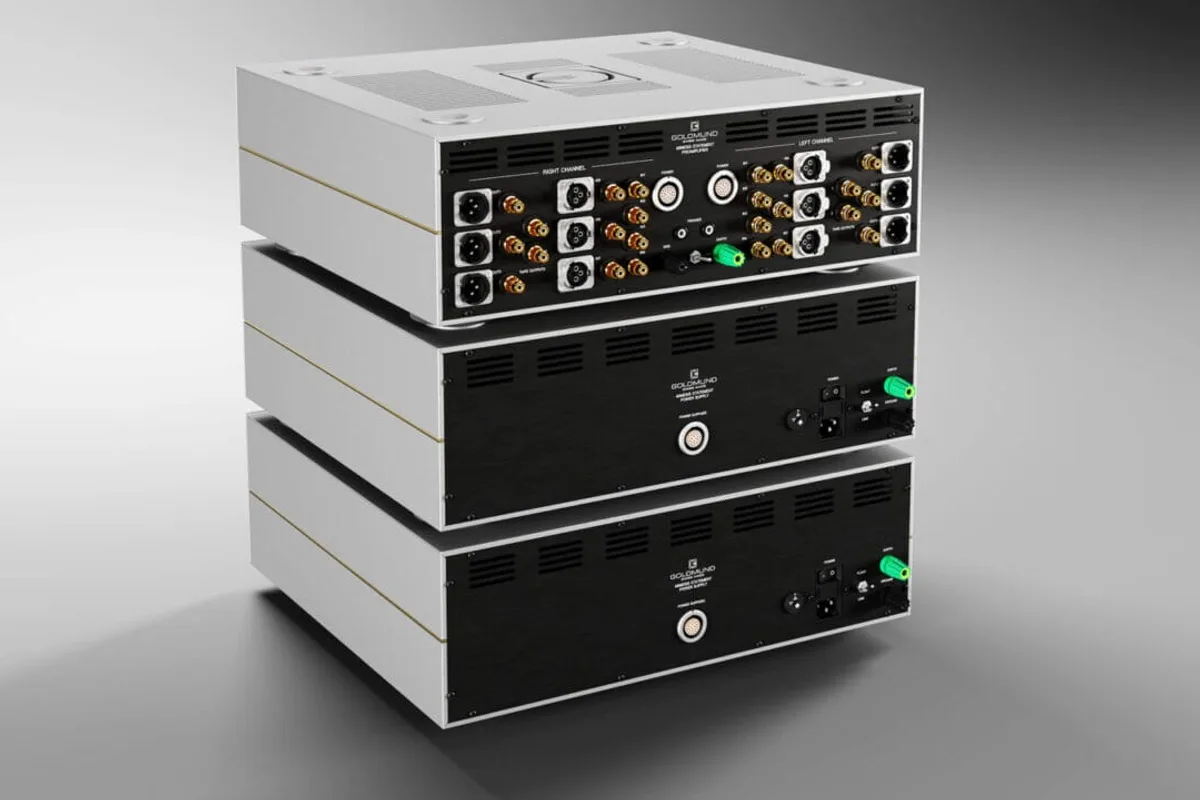
At a time when many audio manufacturers are trying to combine more functions into fewer products, Goldmund is moving in almost the opposite direction. Its new Mimesis Statement preamplifier occupies three separate chassis. One contains the audio circuitry. The other two contain the power supplies. The result resembles a miniature piece of industrial equipment, with stacked silver enclosures, metal controls and a thin gold line running across all three sections. Introduced at the manufacturer's Geneva headquarters on October 19, 2026, the new model sits at the top of Goldmund's analogue preamplifier range. The company has not simply attached two external power supplies to an existing product. It says important components have been redesigned, including the audio board, voltage regulation and volume control. The stated objective is familiar in high-end audio: alter the musical signal as little as possible. The methods are considerably less conventional. With a frequency response reportedly extending to 1.5MHz and exceptionally low distortion figures, Goldmund is presenting electronics designed to push the measurable boundaries of analogue signal handling. That does not automatically mean listeners will hear a dramatic improvement. But the engineering decisions are worth examining.
What does a preamplifier actually do?
Before evaluating the Mimesis Statement, it is useful to understand its role. In a traditional hi-fi system, musical sources produce relatively low-level electrical signals. Those sources might include a CD player, digital-to-analogue converter, network streamer or another compatible component. A preamplifier selects the source, manages signal levels and allows the listener to control volume. It then sends the result to a power amplifier. The power amplifier supplies the energy needed to drive passive loudspeakers. The Mimesis Statement belongs to the first category. It does not replace the power amplifiers. Nor is it presented as an integrated streamer or DAC. Its function may therefore seem relatively narrow. However, the preamplifier occupies a critical point in the audio chain. Unwanted changes introduced at this stage may be passed along and amplified by downstream equipment. A preamplifier must handle small signals, multiple connections and volume adjustment without introducing excessive noise or distortion. Goldmund believes that task justifies an unusually elaborate architecture.
Three chassis designed to separate electrical functions
The most visible design decision is the Mimesis Statement's three-part construction. The main enclosure houses the audio circuitry and controls. A second enclosure provides power for the left channel. A third supplies the right channel. This physical separation serves two objectives. First, it moves potential sources of electrical interference away from circuits handling the audio signal. Second, it aims to reduce interaction between the two stereo channels. Power supplies can generate voltage fluctuations and electrical disturbances associated with their components. Preamplifier engineering must prevent those effects from contaminating the output signal. Designers normally use combinations of regulation, filtering, shielding and careful grounding. Goldmund adds particularly extensive physical separation. Each channel receives its own dedicated power supply. That contributes to a dual-mono architecture. The principle is not new in ultra-high-end audio, but implementing it across three separate chassis remains an expensive and space-consuming approach. It reflects the manufacturer's willingness to prioritize electrical isolation over compactness.
Symmetrical audio circuitry extends the separation
The separation does not stop with the external power supplies. Goldmund has also developed a symmetrical internal arrangement. The left and right channels have dedicated audio circuitry, with signal paths designed to minimize interaction. During the Geneva presentation, the engineering team discussed the approach with What Hi-Fi?. According to the manufacturer, control functions are kept separate from the circuitry directly carrying the musical signal. Input selection, the display and other controls should not unnecessarily interfere with the analogue audio path. The audio board has been redesigned. A component associated with heat dissipation also helps physically separate sections of the circuitry. The objective is to reduce interference and crosstalk, the unwanted leakage of a signal from one channel into the other. In a stereo system, channel separation can help preserve differences between the recorded left and right signals. However, it does not guarantee a more realistic soundstage by itself. The final result also depends on the source, power amplification, speakers and room acoustics. Independent crosstalk measurements would help quantify the benefits of Goldmund's approach.
Two redesigned power supplies target lower noise
Goldmund has devoted considerable attention to voltage regulation. The Mimesis Statement uses a new generation of power supply electronics built around the company's discrete regulation principles. Additional stages are intended to reduce fluctuations and electrical disturbances reaching the audio circuitry. That approach addresses a fundamental challenge in analogue electronics. A musical signal can contain very small variations. Preserving those details requires unwanted noise from other components to remain sufficiently low. Power supply quality is therefore important. Physical separation also creates more freedom for circuit layout. By placing the supplies in dedicated enclosures, Goldmund can organize the signal-processing circuitry with fewer constraints. However, the arrangement introduces additional cables, connectors and mechanical components. It also requires more space on an equipment rack. Any benefit must therefore be judged against the extra complexity. Goldmund claims exceptionally stable electrical conditions. The examined sources do not provide a comprehensive independent comparison against differently designed compact preamplifiers.
Why extend frequency response from 0.2Hz to 1.5MHz?
Among the published specifications, frequency response is arguably the most striking. Goldmund quotes a range of 0.2Hz to 1.5MHz, within a tolerance of plus or minus 3dB. The upper limit extends far beyond human hearing. That does not mean the Mimesis Statement enables people to hear sounds at 1.5MHz. The figure describes the device's electrical bandwidth. Electronics capable of handling rapid signal changes without substantial attenuation may offer useful characteristics for transient behavior. However, a direct relationship between extremely wide bandwidth and audible improvement should not be assumed. Phase response, stability, noise and the complete circuit design also matter. A very wide bandwidth may require careful attention to high-frequency interference and stability. The 1.5MHz specification is therefore best understood as an engineering characteristic. It is not proof of musical superiority in isolation. Goldmund uses it to illustrate its pursuit of signal fidelity. Independent measurements would be needed to establish how that bandwidth behaves under normal operating conditions.
A claimed distortion figure of 0.0002%
The manufacturer also specifies total harmonic distortion plus noise, or THD+N, at 0.0002%. The figure applies to a signal passing from an unbalanced input to an unbalanced output. Goldmund additionally reports intermodulation distortion plus noise of 0.0006%. These measurements describe unwanted electrical components added while processing a signal. Lower values generally indicate closer electrical fidelity to the source. However, the figures need context. Test methods, signal levels, frequencies and connected loads can influence the results. Comparing two devices requires equivalent measurement conditions. Furthermore, an electrically measurable difference is not necessarily audible within a complete music system. Preamplifier quality also depends on behavior across volume settings, when handling high-level sources and when driving different connected equipment. The Mimesis Statement's figures are extremely ambitious. But they are manufacturer specifications. They should not be presented as independently reproduced laboratory results.
Signal-to-noise ratio exceeds 130dB
Goldmund says the Mimesis Statement achieves a signal-to-noise ratio above 130dB on its line inputs. With A-weighting, the claimed figure exceeds 138dB. Signal-to-noise ratio describes the difference between the useful signal level and background noise. A high value indicates very little measured noise relative to the reference signal. That is particularly relevant in a preamplifier. It sits before power amplification, where unwanted noise can also be amplified. However, A-weighted and unweighted measurements do not provide identical information. A-weighting applies a frequency-dependent curve intended to reflect aspects of human hearing. It can therefore produce a different figure from an unweighted measurement. The two specifications should not be treated as interchangeable. Practical relevance also depends on power amplifier gain, speaker sensitivity and listening volume. Exceptionally low electrical noise is technically impressive. It does not necessarily mean every listener will notice an improvement with their existing equipment.
Connectivity remains focused on analogue audio
Despite its sophistication, the Mimesis Statement is not intended to become a self-contained multimedia hub. It is an analogue preamplifier. What Hi-Fi? reports three balanced XLR inputs alongside multiple single-ended RCA inputs, plus outputs using both connection types. These allow several sources and compatible power amplifiers to be connected. XLR connections are common in professional and high-end audio equipment. When properly implemented at both ends, balanced connections can reduce sensitivity to some forms of interference picked up by cables. RCA connections are more familiar in conventional domestic audio systems. Goldmund also provides two Trigger Out connections switching between 0 and 12 volts. They can control the operating state of compatible power amplifiers. That is convenient in a system containing several large components. A single command can simplify switching the system on or off. The Trigger connection does not carry music. It is an electrical control feature for compatible equipment.
The Mimesis Statement partners with Telos 9800 amplifiers
During the Geneva presentation, Goldmund demonstrated the new preamplifier with its Telos 9800 power amplifiers. The configuration described by What Hi-Fi? included two power amplifiers and Theia Passive loudspeakers. Sources included components from Goldmund's Eidos range. That pairing demonstrates the Mimesis Statement's intended position. It is not a standalone product whose asking price represents the complete investment. It forms part of a high-end audio system that may cost substantially more than the preamplifier alone. Goldmund's approach is to control as many variables as possible by combining equipment developed around the same design philosophy. Such demonstrations can be useful for introducing products. However, they also have limitations. When several unfamiliar components are heard together, isolating the contribution of one device becomes difficult. The What Hi-Fi? journalist also noted that the listening room was not fully finished during the visit. A demonstration report is therefore not a substitute for a controlled comparative review of the preamplifier itself.
Why Goldmund chose three boxes rather than four
Electrical separation could be taken even further. Some extremely high-end audio products distribute additional functions among several enclosures. Goldmund nevertheless settled on a three-part arrangement. According to explanations reported by What Hi-Fi?, the engineering team considers it more elegant and less problematic for users than a four-box system. The main unit retains the audio circuitry and controls. The two external enclosures contain the power supplies. That arrangement reflects a design compromise. Goldmund wants to isolate components likely to interfere with one another. However, installation complexity must also remain manageable. Three boxes already take up substantial space. They require specific interconnections and appropriate ventilation. The value of the design should therefore not be judged simply by counting enclosures. Its electrical and thermal organization determines the real benefit. Multiple chassis are a technical means, not an end in themselves.
Minimalist styling hides substantial complexity
Visually, the Mimesis Statement follows Goldmund's established design language. The three enclosures use a silver metallic finish. The front panel combines metal-coated controls with a display protected by glass. A fine gold line runs across the cabinets. It creates visual continuity between components deliberately separated for technical reasons. The result is understated but physically imposing. It does not rely on a large collection of illuminated indicators or elaborate decorative controls. The visual appeal comes from proportions, materials and machining. That matches the Swiss manufacturer's positioning in the ultra-high-end market. The product is intended to be seen within a dedicated hi-fi system. But appearance alone says nothing about sound performance. Luxury construction can carry substantial production costs without necessarily producing an equivalent increase in audible quality. Goldmund argues that mechanical design also contributes to interference control and heat management. Aesthetics are therefore presented alongside engineering. Buyers must decide how much value they place on measured performance, exclusivity and physical craftsmanship.
A six-figure price, but no verified French retail figure
The Mimesis Statement belongs to a product category far removed from mainstream hi-fi. What Hi-Fi? reports a UK price of £220,000. StereoNET publishes a figure of $240,000 and a different British price. Those indications do not agree sufficiently to establish a single worldwide official price. A confirmed French retail price was not found in the examined sources. It would therefore be inappropriate to convert an international figure into euros and describe it as France's definitive retail price. The reported pricing nevertheless establishes the positioning. Goldmund is targeting a customer base for which manufacturing, exclusivity and integration into a complete audio system can carry enormous importance. The expenditure is not limited to the preamplifier's three enclosures. Suitable sources, power amplifiers and loudspeakers are also needed. The complete system may cost substantially more than the Statement itself. In this category, value cannot be assessed in the same way as a conventional integrated amplifier costing a few hundred euros. The question becomes what additional benefit can justify such an exceptional investment.
Transparency does not repair a poor recording
Goldmund's design philosophy is also worth considering. The company says it wants the musical signal to pass through the electronics with minimal alteration. That is different from deliberately making every recording sound warmer, softer or more flattering. A highly transparent preamplifier may faithfully reproduce the strengths of a recording. It may also expose its weaknesses. An aggressively mastered or heavily compressed track does not necessarily become more pleasant simply because it passes through exceptionally precise circuitry. That raises a familiar question in high-end audio. Is the goal to reproduce the source as neutrally as possible, or to create a sound that matches personal preferences? Those objectives are not always identical. Goldmund is clearly emphasizing the first approach. Its low claimed distortion and extensive channel separation support that engineering argument. However, controlled listening comparisons will still be needed to assess how it performs against other reference preamplifiers. Excellent electrical fidelity alone does not establish a universally superior musical experience.
What independent testing should examine
The Mimesis Statement arrives with ambitious specifications and an unusual architecture. Several measurements would be useful for properly evaluating it. The first is distortion across different frequencies and signal levels. Background noise should also be examined at multiple volume settings. Crosstalk measurements could quantify the benefit of the dual-mono design. Frequency response and stability under different loads deserve attention as well. Volume-control behavior is another important factor. A preamplifier should maintain good channel balance even at low listening levels. Balanced and unbalanced inputs and outputs should be assessed separately. Finally, listening comparisons against other reference preamplifiers, using a consistent system and carefully matched levels, would help establish the audible significance of any differences. Journalists in Geneva were able to inspect the product and attend demonstrations. However, the examined coverage does not include a comprehensive set of independently reproduced laboratory measurements. The promise of transparency therefore remains open to further testing.
High-end hi-fi taken to its logical extreme
The Goldmund Mimesis Statement represents a particular vision of high fidelity. It is not designed to simplify installation. It does not add streaming services or combine more functions inside a single chassis. Instead, it multiplies physical components in an attempt to control the electrical behavior of one specific task. Separate power supplies, symmetrical circuitry and redesigned signal paths all serve a coherent objective. Goldmund wants to minimize unwanted changes between the musical source and the power amplifiers. Its published specifications show how far that pursuit can be taken. However, extraordinary numbers do not automatically demonstrate an audible benefit proportional to the price. That is the enduring tension within ultra-high-end audio. Engineering progress can be real, measurable and interesting. Its effect on the listening experience depends on many other factors, including speakers, room acoustics and recording quality. The Mimesis Statement is therefore more than an extremely expensive preamplifier. It is an engineering exercise built around an almost philosophical question: how far should a manufacturer go to make the electronics disappear behind the music? Goldmund's answer occupies three chassis. Independent measurements and controlled comparisons will determine what difference that answer actually makes.