
 By Adri
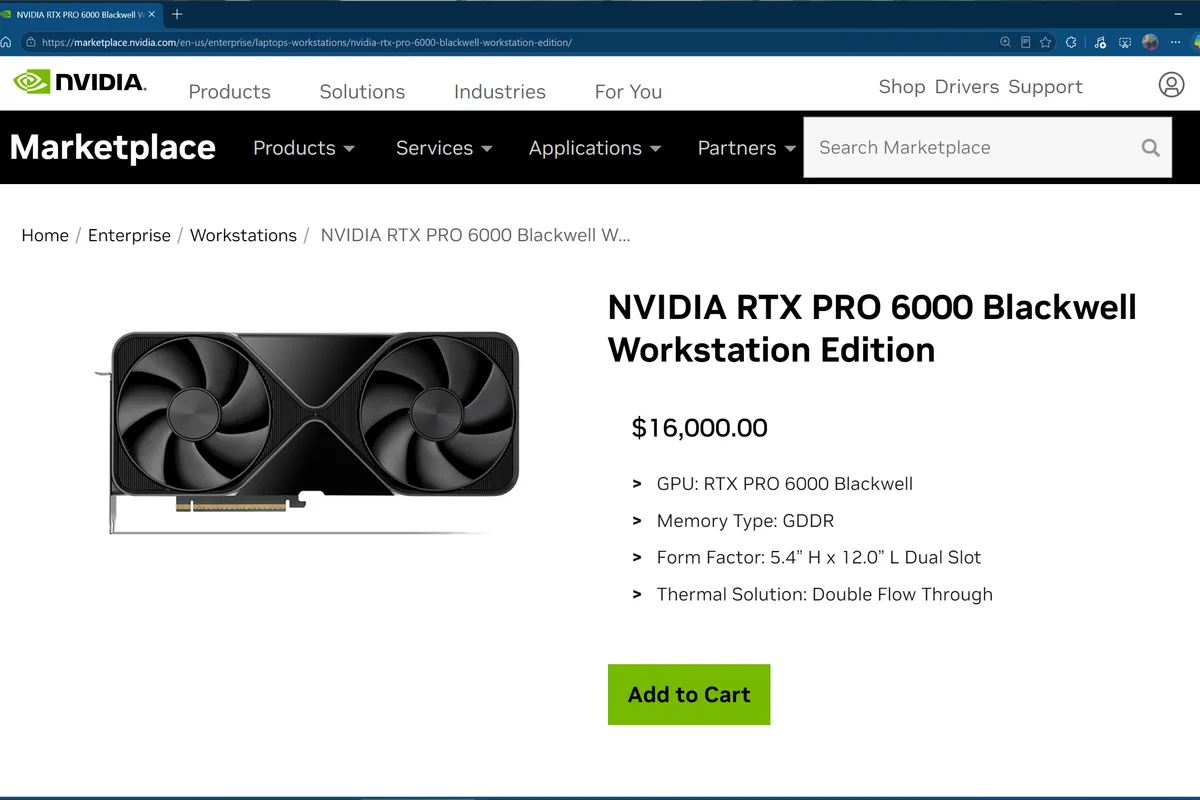
That is a $2,750 increase over the $13,250 Marketplace price documented in June 2026, or about 20.8% in two months. Going further back makes the difference much larger, although one detail is important before calling it a doubled MSRP.
There was no official $8,565 MSRP
NVIDIA announced the RTX PRO Blackwell workstation family on March 18, 2025 and said the RTX PRO 6000 Workstation Edition would begin reaching distribution partners in April. It did not publish a conventional launch MSRP for the card.
Early US commercial listings instead provide the useful baseline. Single cards appeared around $8,565, with bulk pricing around $8,435 and some temporary preorder offers as low as $7,673. Against the $8,565 figure, $16,000 represents an increase of roughly 87%. Using the lowest preorder deal pushes the increase beyond 100%, but it is not the same comparison.
It is still a 96GB Blackwell card
The hardware specification has not been upgraded alongside the price. NVIDIA lists 96GB of ECC GDDR7 memory, 1,792 GB/s of memory bandwidth, 24,064 CUDA cores and a maximum board power of 600W. The company rates the card for up to 4,000 AI TOPS.
Those 96GB are a major part of why this product exists. NVIDIA pitches the card at professional AI development, data science, rendering, engineering and simulation, including local work on models and datasets that would quickly run into the memory limits of consumer GPUs.
A $16,000 GPU changes the workstation calculation
For organizations that specifically need that memory capacity and workstation feature set, a direct comparison with a GeForce card misses much of the point. The more practical change is the upfront cost of building the machine around it. Sixteen thousand dollars buys only the GPU; the CPU, system RAM, storage, chassis, cooling and power delivery still have to follow.
That does not automatically make cloud compute cheaper. The answer depends on utilization, model size, privacy requirements, software and how long the workstation stays productive. It does make the break-even calculation look very different from the one a buyer could have made around an $8,500 card in 2025.
NVIDIA has not given a reason for this specific increase
The broader memory market offers an obvious backdrop. Industry reporting has tied rising graphics-memory costs to strong HBM demand from AI accelerators and memory manufacturers prioritizing higher-value production, tightening supply elsewhere.
NVIDIA itself has not publicly said that GDDR7 prices, supply constraints or any other single factor caused the August adjustment. The company also did not issue formal announcements for the June and August Marketplace increases.
The cleanest number remains the one that requires the fewest assumptions: an early $8,565 US listing in 2025 versus a $16,000 NVIDIA Marketplace price on August 12, 2026, a difference of $7,435.