
 By Adri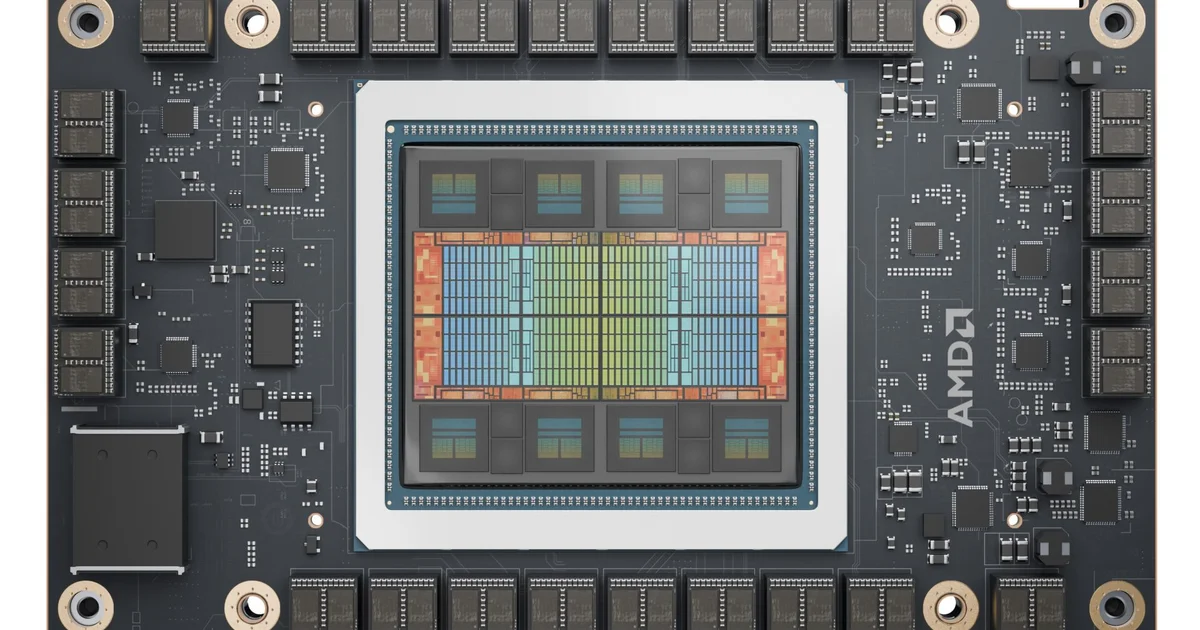
There is a practical problem behind the European debate over AI sovereignty. Companies want access to modern accelerators, reliable software and large amounts of electricity, but they also want control over the infrastructure handling their applications and data. Those priorities do not always point toward the same provider.
Scaleway is attempting to broaden the available choices. On October 13, 2026, at its ai-PULSE event in Paris, the French cloud company announced plans for an AI supercomputer in Sweden built around AMD Instinct MI355X GPUs.
The company describes the project as its first supercomputer deployment outside France and as Europe's first commercially oriented AI supercomputer of this kind based on AMD accelerators. It is intended to serve startups, AI developers and enterprises across the continent.
The announcement is not a launch of an operational service. Scaleway has yet to specify the final GPU count, the project's total computing capacity, its budget or a firm customer availability date. Those omissions are important when evaluating how quickly the installation can influence the market.
The case for AMD is bigger than hardware specifications
Nvidia's position in AI infrastructure is built on more than fast processors. Its CUDA software platform, mature development tools and widespread industry adoption make Nvidia systems convenient for organizations that already run demanding AI workloads.
That convenience can become a dependency. Applications may rely on Nvidia-specific libraries, while cloud suppliers face procurement constraints and pricing exposure when demand concentrates on one hardware ecosystem.
AMD offers a competing accelerator architecture and an alternative software environment. For Scaleway, adding AMD capacity is a way to give customers another option rather than requiring every workload to follow the same hardware path.
The MI355X is part of AMD's Instinct MI350 family, designed for high-performance AI computation. It uses the CDNA 4 architecture and provides substantial high-bandwidth memory capacity, making it relevant to both model training and inference.
AMD specifies up to 288 GB of HBM3E memory and up to 8 TB/s of memory bandwidth for the MI355X. Those characteristics can be important for large models whose performance depends heavily on moving data between memory and processing units.
The architecture supports reduced-precision formats such as FP4 and FP6. Such formats can improve efficiency where the application tolerates them, but they are not a universal guarantee of equivalent output quality or faster execution.
It would be premature to turn those chip-level specifications into a performance ranking for the Swedish system. Cluster behavior depends on networking, workload configuration, memory use and software efficiency. Scaleway has not published enough information to calculate its future installation's aggregate capabilities reliably.
The real competition includes CUDA and ROCm
Software compatibility may prove more important to many customers than peak accelerator throughput.
Scaleway plans to deploy AMD's ROCm software stack alongside the MI355X hardware. ROCm supports widely used AI development frameworks and provides an alternative to Nvidia's proprietary CUDA environment.
The open nature of ROCm offers potential flexibility, particularly for developers seeking to reduce reliance on one vendor's tooling. But openness does not automatically eliminate migration work.
Some machine-learning workflows can operate across different accelerator platforms with relatively modest changes. Others depend on specialized kernels, highly tuned libraries or software components optimized for Nvidia hardware.
For those applications, moving to AMD can require performance testing, changes to dependencies and validation of numerical results. Scaleway's offering will need to make that process manageable if the company wants to attract organizations with established production systems.
This creates an opportunity beyond simply renting out another generation of GPUs. A well-supported commercial ROCm environment in Europe could make it easier for engineering teams to compare platforms using their own models and deployment conditions.
Building a supercomputer takes more than accelerator purchases
Scaleway has assembled an industrial partnership covering the main infrastructure layers required by the project.
French supercomputing specialist Bull will integrate and deploy the cluster, handling elements including rack integration, cooling installation and ongoing hardware maintenance. Giga Computing will provide the servers housing the accelerators.
HPE Networking will supply the high-performance network infrastructure, while VAST Data will provide the data platform. Motul will contribute a specialized cooling fluid designed for the thermal demands of dense computing systems.
Each of these roles addresses a significant operational challenge. Accelerators must exchange information quickly enough to support distributed training and other demanding workloads. Storage must supply large datasets without creating avoidable delays. Cooling infrastructure must remove heat consistently while keeping the system available.
The project will therefore be judged as an integrated machine, not merely a collection of AMD processors.
Until Scaleway provides a final technical configuration and measured performance data, claims about the system's ultimate ranking or efficiency would be speculative.
Why Sweden fits the expansion
Scaleway cites Sweden's technology sector and largely low-carbon electricity supply as important reasons for locating the supercomputer there.
Power availability is a fundamental consideration for AI infrastructure. Large installations require substantial and dependable electricity supplies, and the carbon intensity of that power can influence an operator's environmental footprint.
Northern European locations may also offer advantages for some cooling arrangements, although the actual efficiency of an installation depends on its detailed engineering, operating conditions and energy sources.
The Swedish project builds on an existing commercial relationship. Scaleway entered the market in May 2026 through an agreement with telecommunications operator Tele2 to distribute its cloud and AI services.
Tele2 has publicly welcomed the supercomputer plan as a development that could strengthen Sweden's position in AI infrastructure.
The decision illustrates a broader pattern: cloud providers increasingly choose locations based on a combination of connectivity, energy, market access and regulatory requirements rather than treating computing capacity as geographically interchangeable.
Scaleway is also expanding with Nvidia
Perhaps the most revealing detail in Scaleway's strategy is that the Swedish AMD announcement was accompanied by another infrastructure project.
On the same day, the company announced a planned GPU Zone in Copenhagen using Nvidia HGX B300 systems. The Danish deployment will serve customers looking for advanced Nvidia-based capacity within a European cloud environment.
This is not the behavior of a company seeking to abandon Nvidia altogether. Scaleway is building a multi-architecture portfolio, with different platforms available for workloads that may have different technical and commercial requirements.
The company also outlined additional European cloud expansion scheduled for 2027, including three availability zones in Stockholm and three in Frankfurt.
Its broader infrastructure ambitions encompass GPU Zones in Paris, Copenhagen and Stockholm. Scaleway has described a long-term European footprint involving tens of thousands of GPUs, tens of exaflops and tens of megawatts of capacity.
Those are network-wide ambitions. They should not be presented as specifications for the Swedish AMD supercomputer, whose own scale remains undisclosed.
The strategic logic is straightforward: offer customers more geographic and technological choice while retaining a consistent cloud relationship.
European control does not mean European-made silicon
Scaleway's expansion is framed partly around technological sovereignty. The term is useful only when its meaning is kept precise.
A European-operated cloud can provide organizations with alternatives in contractual arrangements, infrastructure management and the location of data processing. For some workloads, these considerations are crucial.
But the MI355X is designed by AMD, a US semiconductor company, and the wider infrastructure uses components and technologies from international suppliers.
Operating a computing platform in Europe is therefore different from having a fully European semiconductor supply chain.
That does not invalidate the value of the project. Sovereignty can involve degrees of operational control and supplier choice rather than complete technological self-sufficiency.
In practice, diversification may offer more achievable benefits than attempting to replace every foreign technology. Multiple accelerator suppliers and software ecosystems can reduce certain forms of commercial dependence, although they also introduce integration and maintenance requirements.
What remains to be demonstrated
Scaleway's announcement establishes the partners, intended architecture and strategic direction of the Swedish installation. It does not yet establish its economic performance.
Customers still need details about when capacity can be reserved, how much it will cost, what service guarantees will apply and how their workloads will perform on the final infrastructure.
A direct comparison with Nvidia Blackwell systems would also require transparent benchmarks using equivalent models, latency requirements and operating conditions.
Even the project's claim to be a European first needs context. AMD-powered supercomputers already operate in Europe, including Finland's LUMI research system. US cloud companies also provide AMD-based computing services to European customers.
Scaleway's particular claim concerns a commercial AI supercomputer project operated by a European provider. It should not be confused with the first use of AMD accelerators anywhere in European high-performance computing.
These distinctions matter because infrastructure announcements can make future capabilities sound like present-day services. The project has been announced; commercial operation and independently measured results remain future milestones.
A more competitive European market would be the real achievement
For European AI developers, the most valuable outcome would not necessarily be a record-breaking supercomputer.
It would be dependable access to several hardware and software environments, accompanied by clear pricing, suitable development tools and meaningful choices about where workloads are hosted.
If Scaleway can make its Swedish AMD platform attractive for real applications, it could improve competition among cloud computing options available in Europe. If migration proves expensive or the pricing is uncompetitive, the benefits may remain limited to a narrower set of users.
The next significant update will therefore come when Scaleway publishes the system's capacity, launch timetable and commercial conditions, followed by evidence of actual workload performance.
The October 13 announcement is an industrial commitment rather than a completed technical victory. Its importance is that a European cloud provider is preparing to expand the range of choices available to organizations building AI systems.
Whether those choices translate into lower costs, better flexibility or stronger operational control will depend on the finished infrastructure. That is a more demanding test than adding another large GPU installation to the map.