
 By Camille
Samsung is not always chasing the most dramatic specifications in the mid-range smartphone market. Some rivals prioritize enormous batteries. Others advertise extremely powerful processors or charging systems capable of operating at exceptionally high wattages. With the Galaxy F70 5G, Samsung is taking a more conventional approach: a good display, a stabilized primary camera and familiar software features. The phone joins the Galaxy F70e and F70 Pro in the company's Indian lineup. It was introduced on October 18, with sales scheduled to begin on October 20 through Flipkart and Samsung's local channels. Two versions are available. The entry configuration combines 4GB of RAM with 128GB of storage for ₹19,999. The second increases RAM to 6GB while keeping the same storage capacity, at ₹22,999. Selected launch offers can bring the initial price down to ₹17,999, subject to eligibility. The difference matters, but the real interest lies in the choices Samsung has made. This is a coherent specification sheet for the segment, rather than an attempt to lead every category.
A Super AMOLED display is the first major selling point
The Galaxy F70 features a 6.7-inch Super AMOLED panel. Its resolution is 1,080 × 2,340 pixels, with a maximum refresh rate of 90Hz. That combination should suit everyday browsing, video playback and social media. AMOLED technology allows individual pixels to emit their own light, producing deep blacks and high contrast. The 90Hz refresh rate can also make scrolling smoother than on a conventional 60Hz panel. However, applications and system settings must support the higher rate for users to benefit from it. Samsung presents the display as one of the brightest in its price segment. That comparison comes from the manufacturer's own internal research. It is not an independent measurement of outdoor visibility or sustained brightness. The Corning Gorilla Glass Victus protection is another noteworthy feature. It is designed to improve resistance to certain scratches and impacts. However, no smartphone screen is unbreakable, and the outcome of a drop always depends on the circumstances. The phone also retains Samsung's Infinity-U waterdrop notch for the front camera, a more traditional design than the punch-hole displays found on many newer devices.
A 50MP stabilized camera takes priority over raw processing power
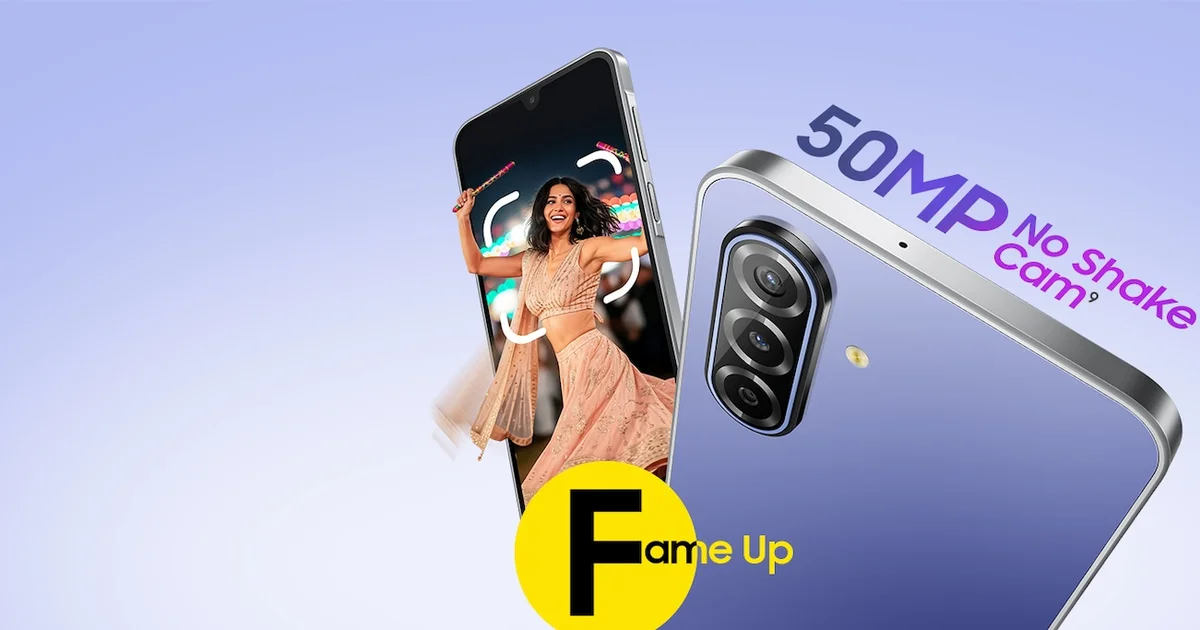
Samsung places considerable emphasis on the Galaxy F70's primary rear camera. The module uses a 50MP sensor with an f/1.8 aperture and optical image stabilization. OIS compensates for some unintended movements during image capture. It can help in lower light and may reduce certain types of shaking during video recording. Samsung calls the feature No Shake Cam. The marketing name is memorable, but it needs context. Optical stabilization cannot freeze a fast-moving subject or guarantee sharp pictures in every situation. Lens quality, sensor design and image processing remain crucial. The Galaxy F70 also includes a 5MP ultrawide camera and a 2MP macro module. These expand the available shooting perspectives, but their relatively low resolutions suggest noticeable compromises. It would be premature to assume that they produce results matching those of the primary camera. A 13MP front camera handles selfies and video calls. Independent testing will need to examine low-light photography, dynamic range and color consistency across the different lenses.
Exynos 1330 is aimed at everyday requirements
Samsung has selected its Exynos 1330 processor. It combines two performance cores capable of reaching 2.4GHz with six efficiency cores clocked at up to 2.0GHz. Graphics processing is handled by the Mali-G68 MP2. The configuration is intended for a phone focused on balanced everyday performance. Messaging, web browsing, video and common applications are natural use cases. Demanding games may work according to their settings and requirements, but this chip should not be confused with a recent flagship processor. Memory also deserves consideration. Four gigabytes may be enough for simple tasks. However, multiple applications, complex webpages and AI-related features can place additional pressure on RAM. The 6GB version may provide useful headroom. Both versions include 128GB of internal storage. MicroSD expansion of up to 2TB is also advertised, although buyers should check for possible restrictions involving a second SIM card. The Galaxy F70 therefore prioritizes balanced operation and expandable storage over maximum computing performance.
A 5,000mAh battery with 25W charging
Samsung equips the phone with a battery rated at 5,000mAh typical capacity. That is a familiar specification among Android smartphones. The manufacturer also reports a minimum rated capacity of 4,855mAh under the relevant measurement conditions. Battery capacity is not a direct measure of runtime. Power consumption depends on the display, network conditions, applications and screen brightness. The phone supports 25W wired charging. That is relatively modest compared with some rivals offering significantly higher charging power. However, maximum wattage alone cannot establish how long a complete charge takes. Actual performance depends on the charging curve and temperature controls. Samsung also states that the compatible power adapter is sold separately. Buyers who do not already own an appropriate charger may therefore face an additional cost. Independent battery and charging tests will be more useful than the headline capacity alone.
A slim 7.5mm body and IP54 protection
The Galaxy F70 measures 164.4mm tall, 77.9mm wide and 7.5mm thick. Its weight is listed at 192 grams. Samsung emphasizes the thin profile. That is attractive for a phone with a large display, although thickness alone does not determine comfort. Width matters, particularly for people accustomed to smaller devices. The phone carries an IP54 protection rating. This specifies a degree of resistance to dust and splashing water under defined test conditions. It may provide reassurance during ordinary everyday use. However, IP54 is not a rating for immersion. The device should not be treated as equivalent to a phone offering higher water-resistance certification. Two finishes are available: Bold Black and Vivid Violet. The black option offers a conventional appearance, while the purple version is more distinctive. These choices fit the phone's positioning: a relatively refined design without the most expensive materials or protections used by premium devices.
Four major Android upgrades are promised
Software support is another important consideration. According to Notebookcheck and Moneycontrol, Samsung plans to provide four generations of major Android upgrades and five years of security updates for the Galaxy F70. That commitment could help extend the phone's useful life. Security patches address vulnerabilities discovered after release. Major Android updates may introduce new features and maintain compatibility with newer applications. However, promised support should be distinguished from actual release schedules. Updates may not arrive simultaneously across every market. Reporting also differs on the exact Android and One UI versions preinstalled at launch. Some sources mention Android 15 and One UI 7, while others do not specify the starting version. That detail should be verified against a complete official specification or a retail device. The important distinction is between Samsung's stated update commitment and the software ultimately delivered over time.
Familiar Google and Samsung features are included
Samsung complements the hardware with several ecosystem features. Circle to Search enables users to search for certain objects and content visible on the display without necessarily leaving the current application. Google Gemini is also promoted for selected AI-assisted interactions. These features do not mean every calculation takes place locally on the Exynos 1330. An internet connection and account may be required. Availability can also depend on the country, language and application. Samsung adds Wallet and Knox. Wallet provides payment-related capabilities where supported, while Knox covers various software security functions. Together, these services can create a familiar experience for people already using Galaxy devices. However, the presence of AI-related software should not obscure hardware limitations. The Galaxy F70 does not necessarily support every advanced capability available on Samsung's much more expensive phones.
A middle position in the Galaxy F70 family
The standard Galaxy F70 joins two existing Indian models. The F70e targets more price-sensitive buyers. The F70 Pro occupies a higher tier. With the standard model, Samsung is offering another balance between price, display quality and photography. That does not make the comparison as simple as ranking three phones from worst to best. Their priorities differ. A cheaper phone may have a larger battery. A more expensive device may offer a faster processor or longer software support. The Galaxy F70 focuses primarily on AMOLED display quality, a stabilized primary camera and a slim profile. Buyers should also examine competing devices available at similar prices. RAM capacity and charging speed may become decisive depending on individual habits. That is particularly relevant in India's highly competitive smartphone market around ₹20,000.
India-only availability is confirmed for now
The Galaxy F70 is scheduled to go on sale in India from October 20. The announced prices apply to that market. Samsung has not confirmed a French launch in the sources examined. It would therefore be incorrect to convert the rupee prices directly into official European retail prices. Taxes, distribution, warranty conditions and configurations may differ. Nor should buyers assume that an equivalent device will automatically appear in Europe under another product name. Samsung regularly tailors smartphone ranges to different markets. For Indian customers, the Galaxy F70 represents a concrete new option. For international readers, it provides a useful example of how Samsung is positioning its mid-range hardware in a competitive region.
A sensible phone whose compromises still need testing
The Galaxy F70 5G is not a revolution in mid-range smartphones. It offers familiar components, including several attractive ones. The 6.7-inch AMOLED display and Gorilla Glass Victus protection stand out. Optical stabilization on the primary camera is potentially useful. The software update commitment may also appeal to people who keep their devices for several years. However, the trade-offs are clear. Charging is limited to 25W. The ultrawide and macro cameras have modest specifications. And the base model's 4GB of RAM may prove restrictive for intensive multitasking. At ₹19,999, the overall package looks coherent on paper. Determining whether it represents good value will require measuring responsiveness, endurance, photographic quality and software stability. Samsung has defined a straightforward proposition: an everyday phone prioritizing a handful of useful features rather than record-breaking numbers. The next question is whether that balance works as well in practice as the specification sheet suggests.